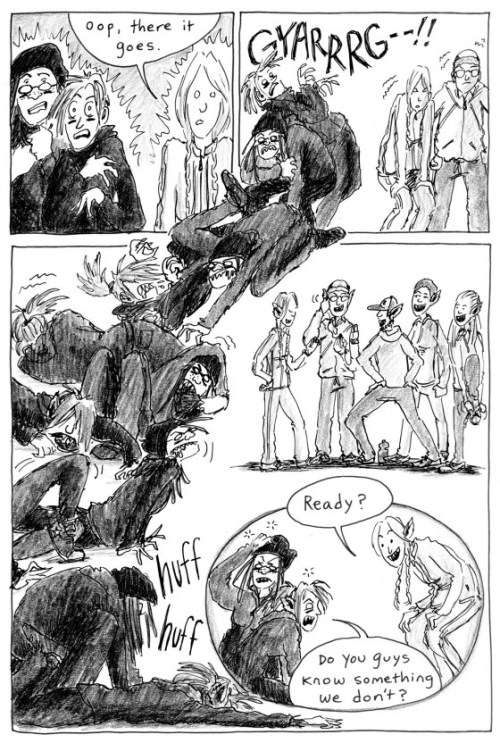
It's once again Women in Horror Month, one of my favorite months, and this year I thought I'd interview a couple cool cartoonists. Starting with my friend, Colleen Frakes!
Colleen graduated from The Center for Cartoon Studies a year ahead of me, and since then has been putting out comics at a pretty incredible rate, many of them horror themed.

Colleen and me partying together, 2011
I've interviewed Colleen about comics, life, horror, and Rocky Horror, please enjoy, and then immediately go read and buy Colleen's work!
Did you grow up reading comics?
I grew up reading Mad Magazine, pulp paperback collections of newspaper comics, and the odd issue of "Archie" or "Ren and Stimpy" comics my parents would pick up when I was sick. I also remember getting to stay up late to watch "The Maxx" on Mtv with my Dad, and getting a few issues of the Sam Keith comic. We tended to live in rural areas where newspaper delivery wasn't an option, and I didn't know graphic novels existed until high school when I came across Jhonen Vasquez's "Johnny the Homicidal Maniac" and Tony Millionaire's "Sock Monkey" at the now-defunct O'Leary's Comics and Books in Tacoma.
How did your life before Vermont lead you to The Center for Cartoon Studies?
Before Vermont I attended The Evergreen State College which has a unique program that puts a lot of emphasis on self-directed learning and self-motivation. It turned out that when left to my own devices all I wanted to do was draw comics. I wrote a one-quarter independent contract where I just tried to figure out HOW to make comics using Scott McCloud's books and circa-2002 internet advice, and ended up with this 20-page mixed media monstrosity on 11x14 illustration board. It was pretty clear that if this was really what I wanted to do for a living, I was going to need help. I applied for grad school both at SCAD and CCS. I was accepted to both, CCS ended up feeling like the better option.
I remember similarly trying to figure out how to make comics in college, and stitching together a hardcover book with original art sewn in for an assignment. They should really teach people how to make mini comics sometime earlier in life.
Seriously! I can remember so many projects in Elementary school that were essentially "make a book" without any discussion of the parts of a book or layout or anything. I'd rather have gotten that than all the diorama knowledge now taking up space in my brain.
I also applied at CCS and another comics school, Joe Kubert. But CCS seemed so much more interesting, and I think I made a much better choice. I feel like a lot has already been said about CCS and that's not what I want this interview to focus on, BUT since this is a horror themed interview I will say if you're into horror CCS is a pretty great place to go, compared to other comics schools. Would you agree?
I think so, at least given the current faculty. Though a few new schools and programs have popped up since I applied to CCS almost ten years ago, it looks like there's something for every creator now!
Visually your comics are very striking, combining beautiful images sometime with violence that you don't seem to shrink away from. For instance one of your werewolf comics has a pretty bloody image as part of the story. Can you talk about the evolution of your style? Do you think about varying it from comic to comic?
Well thank you! I don't always feel like I have control over my style, don't think about it much, and I always find other people's reactions to it interesting. Sometimes I'll draw two characters that, to me, look completely different, but then I find other people can't tell them apart. It's just evolved naturally through repetition. If my math is right, between college and CCS graduation I drew 412 pages of comics. Since then it's been over 600. At some point in there a style just kind of found me.
Some of my choices are deliberate- Early in my career I was told off for drawing characters with "dot eyes", told that they would never be expressive enough. This just made me more committed to always dot eyes. I started my creative career as a playwright in high school, and tend to draw panels simply and at eye-level without a lot of camera angles, like on a stage. I use mainly black and white with large areas of spot black because color is expensive, there are a lot of things I can't draw well, and spot blacks cover those up while looking dramatic. I started off doing mainly silent comics because lettering is difficult, time-consuming, and I don't enjoy it. While I've tried to push myself, move away from some of these crutches and grow as an artist, a lot of have stuck around because they work for me.
Once you've learned how to tell a silent story I think you'll always be better at visual story telling, it's a skill that will still be used in comics with dialogue and narration, and a skill not every cartoonist has. Do you have any advice for folks who are looking to improve their visual story telling?
I think the best way to improve any storytelling is to consume stories- read, watch movies, attend performances. And seek out things you wouldn't normally- it can be trendy to talk shit about modern dance or mime, but both those are visual storytelling. My tools are:
Bee Paper Company's 100lb. Vellum Bristol (I prefer Bee because their papers are milled in the US)
Speedball ink and Rosemary and Co. Kolinsky Sable series 22, size 2 brush
Speedball ink and Rosemary and Co. Kolinsky Sable series 22, size 2 brush
Pentel Pocket brush pen
Zebra Disposable Brush Pens from the Diaso for lettering and a lot of quick comics intended for the web.
Any old mechanical pencils and erasers, I keep a lot of these around because I swear they grow legs and wander off!
Those Rosemary and Co. brushes are great, I bought some with you and used them for years! I'm still using them, but they're long passed their prime. How long do you use a brush? I also have the same difficulty with mechanical pencils, what's that about?I use a brush until I feel like I'm fighting with it to get a good line, when they start to split or lose their elasticity, then they go into the "old brush" pile to use for spot blacks and dry brush work. On that note, I really hate the saying "it's a poor artist that blames his tools". Bad tools produce bad work, or at least make it harder to produce good work!
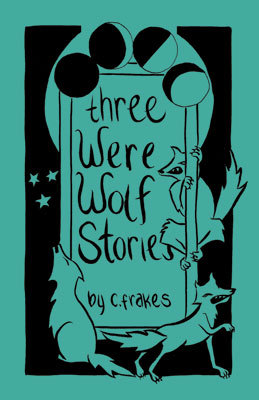
Story wise you seem to divide your stories between auto-bio and folk tale adaptations. What appeals to you about folk tales? Do you consider the writing of the two genres different? How much of your own personal license do you allow in the folk tale adaptations? One thing that struck me with Three Werewolf stories is you tried to find werewolf rules we aren't used to hearing about, like the tomatoes thing, which is kind of hilarious. How was the research on that? What other weird ones did you use?
The thing that draws me to both fold/fairy tales and autobio stories is a desire to preserve the past. I first started drawing fairy tales after a college seminar where is it was revealed that most of my classmates had never heard of a lot of the stories or folk characters I was familiar with- Baba Yaga, the Basket Ogress, Blue Jay stories, I was disturbed by the idea of these oral traditions disappearing. Same thing with autobio- I avoided it for a lot of years, but when it became apparent that a big part of my personal history (McNeil Island) was just going be abandoned and closed off, I felt the need to preserve it. And the only way I know how to do that is through comics and storytelling.
With autobio I try to be as accurate as possible, though some things are condensed or edited for the sake of clarity or believability (the truth is sometimes just too ridiculous, and even after toning it down I get a lot of "did that REALLY happen?" responses). With the fairy tale adaptations, because they're based on oral traditions when the story changes a little between each person, I allow myself a lot of license. Also, to the complete opposite of my autobio work, I tend to revel a bit in the absurd details and the violence of traditional fairy tales. Evil sister gives birth to a scorpion as punishment for Just Being Evil? That's hilarious! Tomatoes cause werewolfism? Okay! You pissed off these three heads floating in a well and now every time you talk you're gonna spit frogs and snakes? Kinda awesome!
Not gonna lie, the jumping off point for all of my research is Wikipedia, then from there I go looking for more source material. Working for a library makes this easy and fun.
For my own werewolf comics I've always tried to find something interesting, like the cajun werewolf myth that's completely connected with catholic guilt. There's just so many more interesting variations of things like werewolves and vampires, it always makes me frustrated or disappointed when I see the same rules over and over. The rules that are more based on Universal movies than anything ancient. Did you get anything like the basket ogress told to you as a threat when you were a kid?
The Basket Ogress story was read to me by my Dad when I was a kid, but not as a threat, just as part of a book of PNW Native Folklore.
Do you think of yourself as a fan of horror? Can you talk a little about horror influences?I consider myself a horror fan, and consider a lot of fairy tales TO BE horror stories (seriously, those things are just full of monsters and dead babies). I read a lot of Stephen King when I was probably too young to, watched horror movies edited for TV with my little sister, my Dad was a fan of old radio shows and I remember being freaked out by a dramatization of Shirley Jackson's "The Lottery" as well as "X-1" and "CBS Radio Mystery Theater". Lately "Welcome to Night Vale" has been a huge influence in the same vein- Denis, do you listen to that show? Denis!!
Honestly, I haven't yet. I have the first few episodes on my itunes, but haven't started them yet. I guess I need to. Anything else I should be listening to or watching?
"Welcome to Night Vale" is the main thing I've been evangelizing lately. I just started watching "Hannibal", though at this point I'm more interested in the color palettes than anything else.
I know you have some history with The Rocky Horror Picture Show, can you talk about that?
Sure! My parents were fans of the movie and use to go to midnight showings at Whitman College, at some point around 4th grade during our latch-key kid years (is that still a thing?) my sister and I came across a cassette tape of the soundtrack and wore that out, found a VHS of the movie and would watch that (fast forwarding to get to the songs) and John Water's "Crybaby" like every day after school. In High School I started attending midnight showings every Saturday at the Blue Mouse Theater in Tacoma, and joined the local RHPS fanclub in order to stay out past city curfew- Tacoma had a midnight curfew at the time for under 18's, but there were a few diners that would let you stay until 2am with a "T-Town Trannies" ID card. The group has since changed their name to the "Blue Mouseketeers" to avoid the offensive term, and only performs twice a month. Attending these midnight shows helped me feel like I was part of a community during some of the most crushingly lonely periods of my life, and this desire for community is a large part of what's kept me in comics even during the times when making comics just felt So Hard.
Really, the RHPS got me interested in theater, and theater led to comics. Though the "don't dream it, be it" motto has stuck with me.
Upcoming projects include the "Nymphonomena" anthology (my favorite comic with a RHPS-like tie in), and finishing several long-form work like Basket Ogress and Island Brat.
After that, I have a science fiction webcomic in the wings, though my only goals for that project are to have fun, draw because I enjoy it, and maybe stop being so depressing.
I'm trying to cut back on conventions in 2014 in order to finish up some of those longer projects, but will be exhibiting at Emerald City Comicon in Seattle (March 28-29) and the Small Press Expo in Bethesda MD (Sept 13-14), and plan to apply to the Short Run Festival in Seattle (Nov 15th).
I'm working on Nymphonomena with you, and I'm not sure how much we should talk about it, but I love this project and it's been going on for so long! I think I drew my graphic novel quicker than this project! Anyone interested can look at Nymphonomena.com.
Now Basket Ogress you've worked on before, are you working from pages you've already done, or starting over?
I've been working on Basket Ogress since 2009. Little work has been done on the project since 2011 when I took a break to submit it to publishers and got some very nice rejection letters. There are two chapters left (remember, the last issue ended with the revelation that there was one more monster left to fight!) then I plan to self-publish it as graphic novel. Where can people buy your comics?
You can buy stuff from me at my website:
Through these web retailers:
http://treesandhills.org/
http://secretacres.com/?wpsc-
http://treesandhills.org/
http://secretacres.com/?wpsc-
Wholesale through Tony Shenton:
http://shenton4sales.tumblr.
http://shenton4sales.tumblr.
And here are the stores that have ordered from me recently:
Phoenix Comics (Seattle)
Jim Hanley's (NYC)
Boxcar Books (Bloomington)
Chicago Comics and Quimby's (Chicago)
Chicago Comics and Quimby's (Chicago)
Fantastic Comics (Berkley)
Thank you, Denis!
Thank you Colleen!